 Best Fabricators
What custom metal fabrication costs
There is no honest per-pound price for custom work. A quote is built from material, labor time, finishing, engineering, and delivery or installation. Here is how to read one.
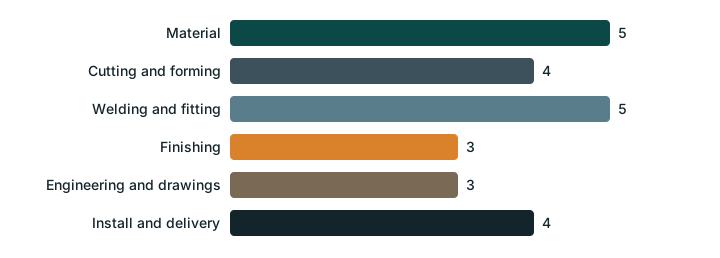
Labor
Labor is usually the largest controllable cost. For context, the Bureau of Labor Statistics reports a median wage of $25.84 an hour ($53,750 a year) for welders, cutters, solderers, and brazers in May 2025.1 Shop rates are higher than wages because they include equipment, overhead, insurance, and profit. Local wages vary; BLS publishes metro-level estimates in its Occupational Employment and Wage Statistics data.2
Material
Steel, stainless, and aluminum prices move with the market, so quotes often expire in days or weeks. Certified or specialty material costs more.
Finishing, engineering, and installation
Galvanizing, powder coat, and polishing can add significant time. Stamped engineering, shop drawings, permits, cranes, and field labor are frequent line items.
Questions
Why do fabrication quotes vary so much?
Shops price risk, overhead, current workload, and what they include differently. Compare scope line by line.
Can I lower the cost of custom metal fabrication?
Use standard material sizes and gauges, loosen tolerances where they do not matter, order more pieces at once, and choose a finish that matches the environment rather than the most expensive option.
- U.S. Bureau of Labor Statistics, Occupational Outlook Handbook, “Welders, Cutters, Solderers, and Brazers,” https://www.bls.gov/ooh/production/welders-cutters-solderers-and-brazers.htm, read November 11, 2026. ↩
- U.S. Bureau of Labor Statistics, Occupational Employment and Wage Statistics, https://www.bls.gov/oes/. ↩